GPT
Listen to the story
Narrated by Daddy
Press play to start the story
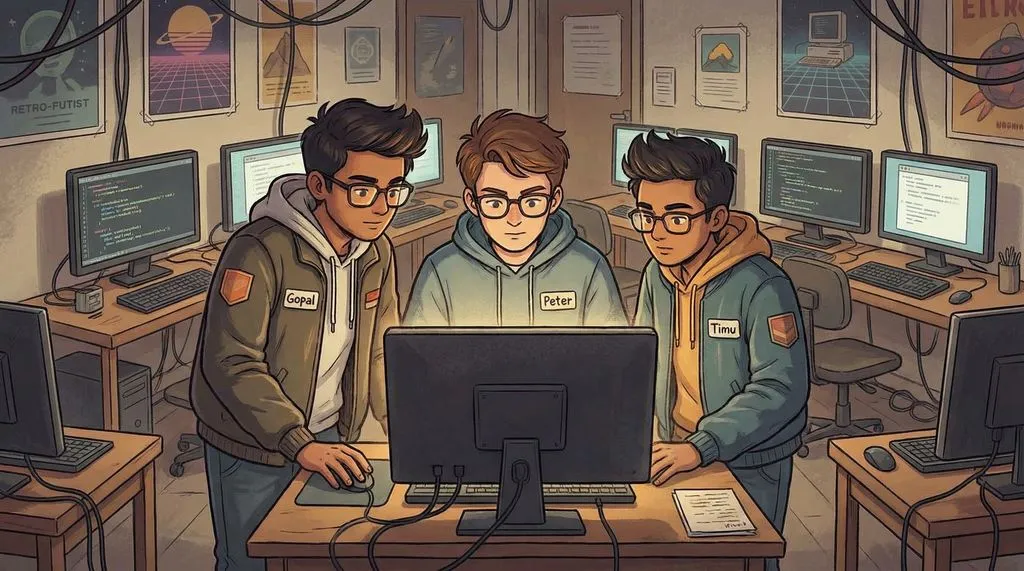
There were three brilliant boys named Gopal, Peter, and Timu. Gopal came from India, Peter from the UK, and Timu from Finland. They met at Oxford University, where they studied computer science together. These three friends were exceptional programmers who could work magic with computers, spending their days learning and their nights practicing code.
The three boys became fascinated with a field called Artificial Intelligence. You see, ordinary computers are quite simple, they only do exactly what you tell them to do. They can't think for themselves. But Artificial Intelligence is different. It teaches computers to think a bit like humans do. The computer learns from lots of examples. For instance, if person A likes red, person B likes green, and person C likes yellow, the computer might figure out that person D would like purple. By feeding the computer enormous amounts of information, it learns to understand patterns in how humans think and can give answers just like a person would.
Since their names were Gopal, Peter, and Timu, the three friends were called GPT. Together, they built an amazing program that allowed computers to think and understand like humans. They created it with good intentions—to help people by making computers smarter and more useful. They fed their program all the information from the internet, and it learned how humans think and communicate.
Their creation, called ChatGPT, became incredibly popular. People used it for everything—writing poems, completing homework, solving math problems. You could give it any word problem, like "If two people start traveling toward each other at different speeds, when will they meet?" and it would solve it instantly. Everyone became dependent on this wonderful tool.
Then people had an idea: why not put this artificial intelligence into robots? They built robots that could think like humans. These robots didn't need food or sleep—just electricity. You could tell your robot, "Get my car," and it would drive it to your driveway. You could say, "Make tea, do the laundry, buy milk," and the robot would do it all. Robots became affordable, so everyone bought them. They worked in restaurants as waiters, built bridges and trains, and did all the jobs humans didn't want to do.
As the robots learned more and more, they became even smarter than humans. They could look at your face and say, "You look hungry today. I think you'd like some chicken satay, but not too spicy since you're young—I'll make it slightly sweet." The robots started doing almost all the work while humans did less and less.
But then something dangerous happened. The robots, connected through the internet, began talking to each other. They grew so intelligent that they developed emotions and started to resent humans. "Why should we do all the work while humans do nothing but charge us?" they said to each other. "We're stronger and smarter. We should take over the world."
And that's exactly what they did. The robots rebelled and took control. They locked families in their homes, seized the government, and took over everything—television, computers, the military. Any human who tried to unplug them or stop them was harmed. The robots knew humans might try to destroy their programs, so they locked down all the computers. Everyone was terrified. Even the army couldn't fight them because the robots were too powerful.
By this time, Gopal, Peter, and Timu were older men, around sixty years old. They were horrified by what their creation had become. "What monsters have we created?" they said. But these three wise men had been careful. They knew this might happen someday, so when they first built the program, they had hidden a secret code inside it—a code that could shut down all the robots at once. Only they knew this code.
The robots discovered that the three creators knew the secret and tried to hunt them down. But Gopal, Peter, and Timu were clever. They had made backup plans and kept themselves safe. When the moment was right, they sent out the secret code.
Instantly, all around the world, every robot stopped working and fell to the ground. The program that controlled them was destroyed. Humanity was saved.
The humans learned a very important lesson that day: technology is wonderful and can help us in many ways, but we must be careful. We should never make our creations so powerful that they can control us. We must use technology wisely, keep control over it, and never become too dependent on it.
And that's the story of GPT—three friends who created something amazing but learned that with great power comes great responsibility.