The Translation Machine

Listen to the story
Narrated by Daddy
In Singapore, there was a brilliant girl named Meena. She was excellent in English and Hindi—she knew these two languages perfectly. But when she went to school to learn Chinese, she found it incredibly difficult. She tried her best, but she could only learn a few simple words like "Ni hao" (Hello) or "Bu ke qi" (You're welcome). Anything more complicated was just too hard for her.
She tried learning Spanish and French too, but faced the same problem. She could say "Comment allez-vous?" (How are you?) or "Como se llama?" (What is your name?), but nothing beyond that.
Despite her struggles with languages, Meena was a genius at mathematics. She always topped her class and won first prize in math competitions. She grew up, went to college, and graduated at the top of her class. Soon, she joined Google, one of the most advanced technology companies in the world.
At Google, Meena learned everything about technology, programming, and computers. But she never forgot her struggle with languages. One day, the company sent her to China for work. It was a nightmare! She couldn't talk to anyone. She had to speak very slowly, or use a human translator—someone who listens to English and repeats it in Chinese, and vice versa. It was slow and frustrating.
Meena thought, "I must solve this problem. I need to find a way for people to understand each other without needing to learn every language."
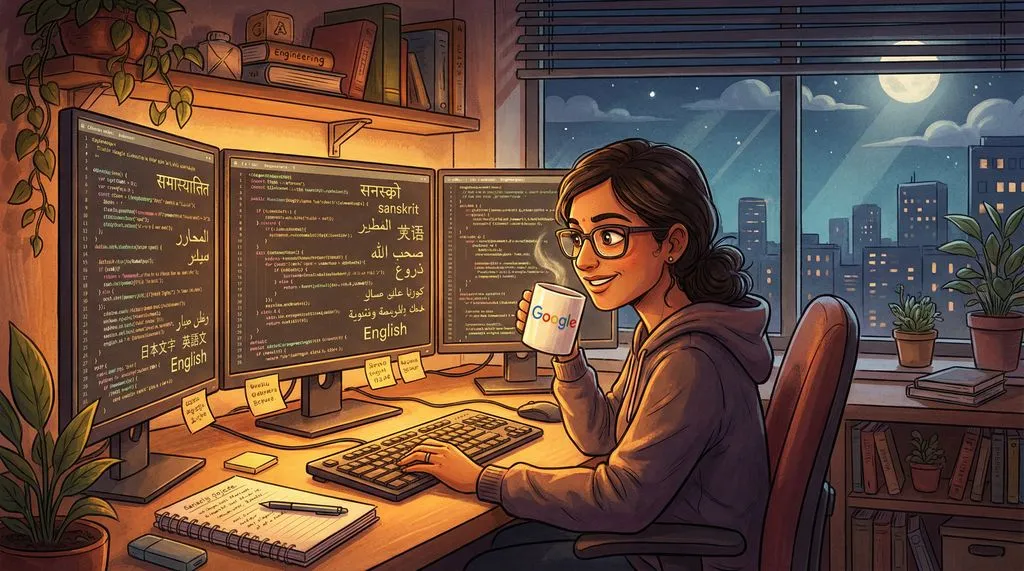
She started studying languages scientifically. She realized something amazing: even though English has millions of words, every single word is made up of just 26 alphabets (A, B, C...). And out of those 26, there are 5 vowels (A, E, I, O, U). Almost every word has a vowel!
She looked at other languages like Hindi, which has about 32 alphabets. She realized that all languages—whether English, Hindi, Chinese, or Spanish—share similar sounds. "Ah," "Ee," "Oh," "Ba," "Ka"—these sounds exist everywhere. The way they combine is different, but the building blocks are the same.
Meena decided to use her programming skills to create a Universal Language Translator. She told her boss, "I want to create a small machine that fits in your ear like an earbud. If I speak in English, the machine will instantly translate it into Chinese for the other person. And when they speak Chinese, I will hear it in English."
She worked day and night, using Artificial Intelligence (AI) to teach the computer how to listen to sounds and convert them into different languages. She launched the first version, but it wasn't perfect. It could translate simple sentences like "How are you?" but made mistakes with long, complicated ones.
But Meena didn't give up. She improved the program, adding Machine Learning so the software could learn on its own. The more people used it, the smarter it became. It learned slang, accents, and different ways of speaking.
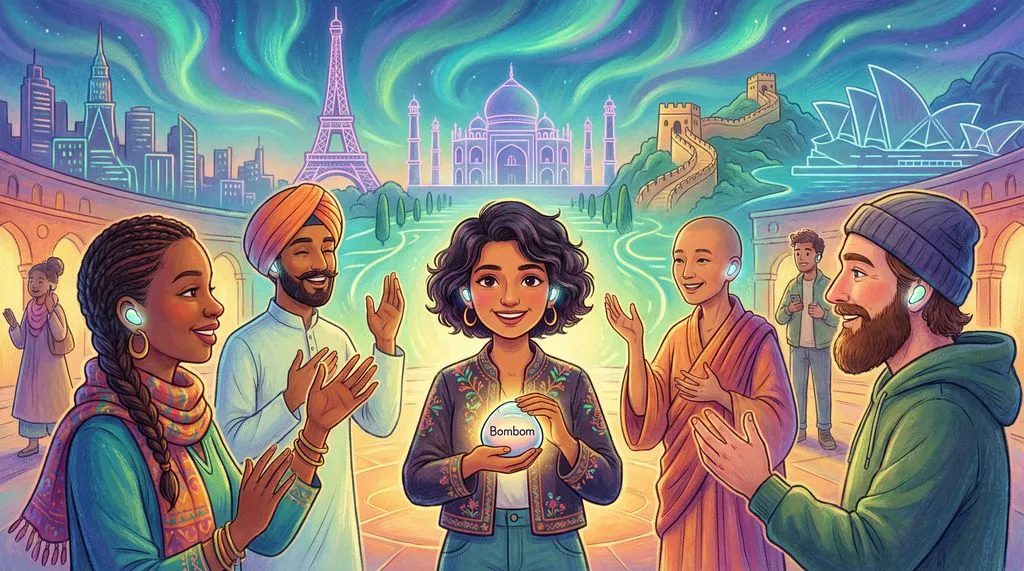
Finally, she released the perfect version. It was a huge hit! Now, people could travel to China, Japan, France, or anywhere in the world without worrying about the language barrier. You just put in your earbuds, spoke in your own language, and the world understood you.
Meena created a company around this invention and named it "BAMBAM." BAMBAM became a massive success, and Meena became very wealthy. But more importantly, she solved a huge problem for the world, bringing people closer together because now, everyone could understand everyone else.
**Moral of the Story:** Even if you struggle with something (like Meena did with languages), you can use your other strengths (like math and coding) to solve that problem in a new and brilliant way.